
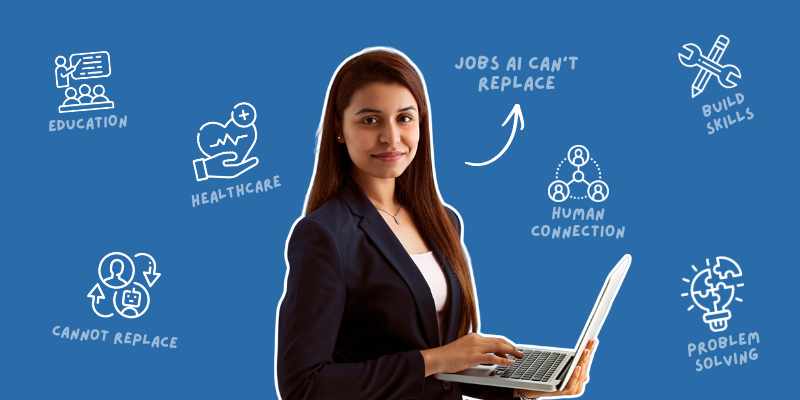


There is no doubt that conversations around AI job loss and AI taking over jobs are everywhere right now. It is natural to wonder, will AI take over jobs, or even more personally, will AI take my job?
The reality is more balanced than it seems. While AI is changing how we work, it is not replacing everything. In fact, there are entire categories of roles where human judgement, empathy, creativity, and real-world interaction still matter deeply.
Understanding these roles can help you identify which AI jobs are at risk. So, let us explore all the details you need here.
Why AI Cannot Replace Every Job
AI helps process repetitive data and can save time as well. It struggles where unpredictability, human emotion, and physical presence are involved. This is where humans continue to have an edge.
- Jobs focusing on empathy and the emotional side of humans.
- Comple decision making roles.
- Roles that are based on conditions and analysis.
- Creative, storytelling, and artistic roles.
- Jobs that need you to connect with people.
This is why AI and job loss should focus on adaptation and skill development as well.
7 Jobs AI Can’t Replace
While there are various concerns about AI taking jobs, not all of them are true. There are still various jobs that AI can't replace. The top ones among them are as follows:
1. Healthcare Professionals
Healthcare is not just about diagnosis; it is about care, trust, and responsibility. There is no doubt that AI can analyse patterns quickly and accurately. But still, it cannot use them to make the decisions needed.
Doctors and nurses often make decisions involving emotions, ethics, and uncertainty. A patient does not just need treatment; they need reassurance. These humans are the part that makes it reliable. It is one of the least replaceable fields, even when there are AI jobs at risk.
2. Teachers And Educators
Learning is deeply personal. It needs to have an expert who can guide and explain concepts well. There is a different pace and mindset for each learner that needs to be focused.
A good teacher does more than explain concepts. They motivate, adjust their approach, and build confidence. AI may assist in education, but it cannot replace the emotional and psychological support that shapes real learning outcomes.
3. Skilled Trades And Technicians
We actually need people to do small tasks on a daily basis. Starting from a plumber to an electrician, these jobs need precision and technique.
These roles require quick thinking, physical skill, and real-time problem-solving. No two situations are exactly the same. AI struggles in such dynamic environments because it depends heavily on structured data and controlled settings, which these jobs rarely offer.
4. Creative Professionals
There is a lot of debate around AI in creative work, especially with rising concerns about AI job loss. But true creativity goes beyond generating content.
It involves context, lived experience, and emotional depth. Creative professionals create content or art that connects. It tells a story that can help people to know the brand or the idea behind. AI can assist with ideas or drafts, but originality and storytelling still come from human insight.
5. Leadership And Management Roles
Every company has these roles. Many think that these are focused on feedback and decisions. But in reality, they do more than that. It is focused on responsibility and taking people along to ensure the growth of all.
Managers deal with team dynamics, conflicts, and motivation. It requires experience and various other aspects to face the challenges. AI can support decision-making, but it cannot lead people as humans can.
6. Social Workers And Counsellors
These roles are built entirely on trust, empathy, and human connection. People in difficult situations need these experts who are ready to listen to them and not make judgement calls.
AI can provide suggestions or mental health tools, but it cannot truly replace human empathy. The ability to connect, listen without judgment, and support someone emotionally keeps these roles far from AI jobs loss.
7. Sales And Relationship-Based Roles
In many industries, especially finance and consulting, decisions are driven by trust. People prefer to connect with the experts who know the products and services. The idea is to guide the buyer or client to ensure they know the details they need.
Sales today are less about pushing products and more about building relationships. This involves communication, emotional intelligence, and adaptability, areas where AI still has clear limitations.
How To Stay Relevant In The Age Of AI
It is easy to focus on AI job loss, but the more practical approach is to focus on control. The way work is evolving does not mean everything is at risk. It means the value of your role is shifting.
Instead of asking will AI take over jobs, the better question is how you can stay useful, adaptable, and ahead of change. Here is how you can do that in a more practical way.
1. Move From Task Execution To Problem Solving
Roles built solely on completing tasks are most at risk from AI jobs. What makes you valuable is not just doing the work, but understanding why it is being done.
Start asking:
- What problem is this solving?
- Can this process be improved?
- What decisions depend on this work?
When you understand this you will get to know that these roles are one that need deep human skills and not just automation.
2. Build Skills That AI Cannot Replicate Easily
AI is strong with data and patterns, but it struggles with human nuance. This is where you need to focus.
- Clear communication and storytelling.
- Emotional intelligence in conversations.
- Decision-making in uncertain situations.
These skills are not just “nice to have”. They are what protect you from long-term AI and job loss risks.
3. Learn How To Work With AI, Not Against It
There is no doubt that AI is here and will stay. So, to gain the most, you must learn the same and not just fear it. Instead of worrying about AI taking over jobs, start exploring:
- How AI tools can speed up your work.
- Where automation can reduce repetitive effort.
- How can you focus more on thinking and less on routine tasks?
This shift alone can make a big difference in your career growth.
4. Strengthen Your Domain Expertise
General skills are easier to replace. Depth is harder to replace.
Pick a domain and go deeper:
- Understand industry trends.
- Build practical knowledge.
- Stay updated with changes in your field.
When you combine domain expertise with human skills, your role becomes far less vulnerable to AI jobs loss.
5. Focus On Relationship And Trust Building
When it comes to roles that require you to connect with clients, trust is key. People still prefer working with people who:
- Understand their needs.
- Communicate clearly.
- Offer personalised guidance.
This is the reason why AI cannot take over such jobs. These jobs need to have the skills and empathy at the same time which is the key to making these roles relevant.
6. Stay Adaptable And Keep Learning
The biggest risk is not AI. It is staying the same while everything else changes. This is the reason why you should focus on upskilling as well. Some of the things to know are:
- Take short courses when needed.
- Experiment with new tools.
- Stay curious about how your industry is evolving.
Adaptability is what helps you stay ahead even when AI job loss becomes more visible.
How Choice Connect Helps You Stay Relevant In The Age Of AI
As concerns around AI job loss and AI taking over jobs grow, the focus is shifting towards roles that need human interaction and trust. Choice Connect offers you opportunities that can help you build a sustainable career even when AI is taking over. Some of the reasons that you must know are as follows:
- Helps you build a career where you guide people in financial decisions, something AI cannot replace easily.
- Gives access to different financial products, so you are not dependent on just one income source.
- Offers earnings based on your effort that reduces the risk of AI jobs loss.
- Provides basic training and support to help you get started without confusion.
- Help you with skills and communication that focus on growth.
Final Thoughts
The fear around AI job loss is real, and there is no doubt that you need to stay aware. But you also need to understand that not all jobs are at risk of being replaced by AI.
If you are thinking will AI take my job, take a moment to think again. There are skills that you might be missing that can impact your job. This is where platforms like Choice Connect can help you.
If you want to explore a path that grows with you and is less exposed to AI taking over jobs, you can get started with Choice Connect and begin building your own income stream today.
FAQs
1. Is AI going to take our jobs?
AI will change how work is done, but it will not take all jobs. It will automate tasks, while many roles will still need human judgement, creativity, and interaction.
2. Will AI replace 80% of jobs?
No, that is unlikely. While some jobs may shrink or change, most roles will evolve rather than disappear completely, especially those that require human skills.
3. What jobs will escape AI?
Jobs that involve empathy, creativity, decision-making, and real-world interaction are less likely to be replaced. These include healthcare, teaching, leadership, and relationship-based roles.
4. Which jobs will be gone by 2030?
Jobs that are repetitive and rule-based, like data entry, basic support, and routine processing roles, are more likely to decline as automation increases.
5. What skills I should have to stay ahead in AI era?
There are many skills, like communication, decision-making, and emotional intelligence, that will help you. These skills cannot be replicated with AI. This is why they offer you the edge.

