
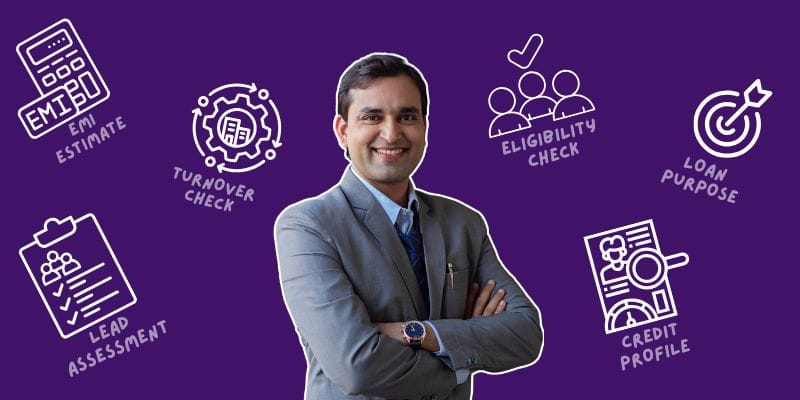


Key Highlights:
- A calculator gives agents an early view of the EMI a borrower may need to manage.
- Loan eligibility depends on several factors beyond the amount requested.
- Agents can use early financial details to fins strong leads that can be easily converted.
- The borrower’s purpose for the funds can help determine the right type of business financing.
- Calculator results are indicative and should never be presented as a confirmed sanction.
A business owner may approach an agent asking for ₹5 lakh, ₹20 lakh or even ₹50 lakh. The amount they need, however, may differ significantly from the amount a lender is willing to approve.
This is where preliminary assessment becomes important. Understanding business loan eligibility can help agents to find strong leads and invest in converting them.
For an agent, therefore, a calculator is useful when it starts a conversation rather than ends one.
What Does a Business Loan Calculator Tell an Agent?
Most business loan EMI calculators work with three main inputs: the loan amount, interest rate, and repayment tenure. Based on these figures, they estimate the monthly EMI and total repayment.
For a business loan agent, the EMI is the useful part.
Suppose a client wants ₹15 lakh. Before moving ahead with the application, the agent can test different tenures and estimated interest rates. This gives both the agent and borrower an idea of the monthly repayment that may follow.
An EMI estimate can help answer an early question: Does this borrowing requirement appear practical, considering the cash flow available to the business?
It can also help the agent show the client how changing the tenure affects the monthly repayment. A longer tenure may reduce the EMI, although the overall interest outgo may increase.
However, agents should make it clear that a calculator provides an estimate. Actual pricing, sanctioned amount, and tenure depend on the lender’s assessment.
How Should Agents Understand Business Loan Eligibility?
To assess business loan eligibility, you would need to check the business's age, financial status, KYC, and credit score. You may be asked to share GST data and other information as well. Some of the key points that you should know are as follows:
1. Check How Long the Business Has Been Operating
If your business has been running for years, then this can be a strong point for getting the loan. This is where you will be asked to share the details, such as:
- Nature of business
- Status of finances
- The KYC
- GST and taxation status
- Owner documents
Agents should therefore ask all these details before actually starting and moving ahead. This will help determine whether the same can be verified quickly.
2. Understand Turnover and Profitability
Turnover indicates the scale of the business, but turnover alone does not show repayment capacity.
Two companies may generate the same annual sales while having very different profit margins, expenses, and debt commitments.
An agent should ideally understand recent turnover alongside profit, cash flow and bank statement behaviour before deciding whether the requested loan amount appears reasonable.
3. Review Existing Loans and EMIs
Existing borrowing affects how much additional repayment pressure a business can manage.
A client may have strong revenue but already be paying several loans. Another business with slightly lower revenue may have very few existing obligations.
This is why existing EMIs should be checked before using a repayment estimate to judge affordability.
4. Look at the Credit Profile
Credit history remains an important part of lending assessment. If the applicant has a strong credit history, the chances of loan application approval increase. Also, a key checkpoint here is how well the previous loans or even credit card repayments were done. This will help greatly.
5. Check Banking Behaviour and Documents
Bank statements can tell lenders a great deal about how a business operates.
Regular inflows, sufficient balances, and predictable transactions can support the assessment. If there are recent fallouts or situations where your applicant was rejected, it can be bad for the chances of approval.
Agents should also check whether basic documents such as PAN, GST details, ITRs, financial statements, and business bank statements are available before submitting the case.
How Can Calculator Results Help With Preliminary Lead Assessment?
An agent does not need to perform the lender’s complete credit assessment. That remains the lender’s responsibility.
The agent can, however, identify whether a lead appears ready for the next step. A simple preliminary check could look like this:
| Check | What the Agent Should Understand |
|---|---|
| Funding requirement | How much does the business actually need? |
| Purpose | Working capital, machinery, expansion or another business need |
| Turnover | Does business activity support the requested amount? |
| Profit and cash flow | Is there room for another monthly repayment? |
| Existing EMIs | How much debt is already being serviced? |
| Business vintage | How long has the business operated? |
| Credit profile | Is there any major repayment concern? |
| Documents | Are basic financial and KYC records available? |
This process can save time at both ends.
A lead with incomplete financial records may need preparation before submission. Another client may have a sound profile but be requesting a loan amount that results in an uncomfortable EMI.
Identifying such issues early allows the agent to have a more useful conversation with the borrower.
How Can Agents Match Borrowers With the Right Business Loan Category?
Finding the right business loan category for a client is based on the need for the loan and the tenure as well. Some of the key details to know here are as follows:
1. Working Capital Requirements
A business may need funds to buy stock, pay suppliers, or manage a temporary cash-flow gap. The agent should understand whether the requirement is recurring or one-time. If the fund is required for daily working, then going for an overdraft facility is a good choice.
2. Business Expansion
A borrower opening another branch, increasing capacity or entering a new market may need a larger amount over a longer period. Here, the agent should look at the expected cost of expansion and whether existing business cash flows can support repayment.
3. Machinery or Equipment Purchase
Businesses purchasing machinery or equipment have a clearly defined use for the money. The asset cost, expected business benefit and available contribution from the borrower can help the agent understand the funding requirement more accurately.
4. Secured Versus Unsecured Borrowing
Some borrowers may qualify for an unsecured loan, while others may need a secured lending option to access the amount they require.
The agent should avoid pushing every business owner towards the same product simply because that product is easier to explain.
The better approach is to understand the requirement first and then explore lenders and loan categories that suit the profile.
What Should Agents Explain Before Submitting a Business Loan Application?
A strong preliminary assessment can improve the quality of conversations, but agents should avoid giving borrowers an impression that eligibility has already been confirmed.
The final decision sits with the lender.
Explain that interest rates, loan amount, and tenure can change after the lender reviews the applicant’s financial position, credit profile, and documents. An estimate should therefore be treated as a planning figure.
Agents should also avoid sending the same application to every lender without first understanding the borrower.
Instead, look at the profile, requirement, and available lender criteria. This gives the application a clearer direction.
Agents looking to distribute various lending products can explore the Choice Connect financial platform to understand the products available to clients. Choice Connect currently supports partners across loans and other financial services.
Those specifically interested in this segment can also become a loan agent and access digital registration, training support, lead tracking, and backend assistance through the platform.
Conclusion
For a business loan agent, a calculator is most useful before the application is submitted to the lender.
It helps turn a broad request, such as I need ₹20 lakh into a more practical discussion about repayment, business finances, and borrowing capacity.
From there, the agent can check the borrower’s turnover, cash flow, existing obligations, business history, and funding purpose. The aim is not to predict the lender’s decision. It is to understand the case well enough to take it in the right direction.
That can mean stronger leads, more relevant lender matching, and clearer conversations with business owners.
Want to build your business loan distribution practice? Start exploring opportunities with Choice Connect to start your career as a financial agent.
FAQs
1. Can an Agent Check Business Loan Eligibility Before Applying?
Yes. As a business loan agent, you can check if the person is eligible or not. But the details or the approval will always be shared post-application only.
2. Does High Business Turnover Guarantee Loan Approval?
No. Lenders usually check other details as well. This includes the profitability, cash flow, repayment history, existing obligations, and banking behaviour. These things combined define your loan approval status.
3. What Documents Should an Agent Ask for First?
Agents can begin with KYC, business documents, GST, and other financial history documents. The exact need will be based on the nature of the business and lender's needs.
4. Can a Business Owner Get a Loan Without Collateral?
Yes, unsecured business loans are available from various lenders. But these are mostly available only after years of a business relationship with a bank.
5. How Can a Business Loan Agent Improve Lead Quality?
Start by understanding the purpose of the funding, the required amount, and the nature of the business. Understand the needs, and based on the same, you will be able to check the quality of the lead.

