


Key Highlights
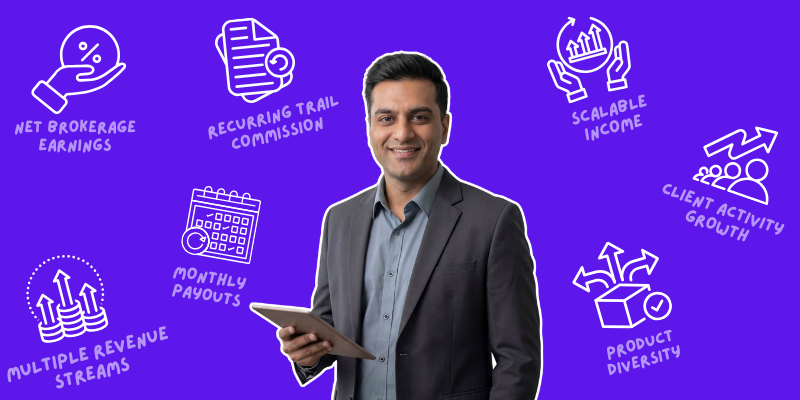
- AP earnings in revenue sharing model are mainly from the net brokerage. This is after statutory deductions like GST and exchange charges.
- Your income scales with client activity and product mix. So, the number of clients and their involvement both play an important role for you.
- A strong AP model builds recurring income through trails and cross-sell, not just one-time brokerage commissions.
If you are exploring how to earn from the stock market without becoming a full broker, you have likely come across the term revenue-sharing model. This is the core earning structure behind the Authorised Person (AP) role, formerly known as a sub-broker in India. It sounds simple. You bring clients, they trade, you get a cut. But most explanations stop there.
This blog breaks down exactly how AP commission works, what affects your payout, and how to build an income that actually compounds over time.
What Is the Revenue Sharing Model?
The revenue sharing model is a commercial arrangement between a SEBI-registered stockbroker and their Authorised Person. When clients who are under your AP code execute trades, the broker earns brokerage. A pre-agreed percentage of that brokerage is passed on to you as your commission.
This model replaced the older sub-broker structure after SEBI discontinued new sub-broker registrations in 2018. All sub-brokers were asked to transition to the AP framework. The terminology changed, but the income logic remained the same: your earnings grow in direct proportion to how actively your clients participate in the market.
The appeal is straightforward. You operate under the stockbroker's regulatory umbrella while building your own client base and business. This is one of the reasons why becoming an AP is a good starting point.
How AP Commission Is Actually Calculated
Most guides mention a percentage range and move on. Here is what actually happens before your payout is determined.
Step 1: Client Trades, Brokerage is Charged
When your mapped client executes a trade, the broker charges them a brokerage fee. This depends on the broker. It means that this could be a flat fee per order or one where the percent is being calculated.
Step 2: Statutory Deductions are Applied First
Before revenue sharing begins, charges are removed. These are the charges, like GST (18% on brokerage), exchange transaction fees, and SEBI turnover charges. These flow to the regulator and exchange. This is why these charges are not part of your actual income.
Step 3: Net Brokerage Becomes the Shared Pool
The net brokerage is the amount after all the deductions. This is the base on which your sub-broker commission is calculated. Now, say this is the percentage, then the same amount will be used for the calculation.
Step 4: Your Share is Calculated and Paid Monthly
If your agreed revenue sharing ratio is 60%, you receive 60% of the net brokerage generated by your clients that month.
A real example
Suppose your clients generate gross brokerage of Rs. 1,00,000 in a month. After approximately 20% in statutory deductions, the net pool is Rs. 80,000. At a 60% revenue share, your payout is Rs. 48,000. Scale that with 100 active clients over 12 months, and the compounding potential becomes clear.
What Determines Your Revenue Share Percentage?
AP commission percentage is based on various factors in India. It is generally 20-70%. This is based on various factors, and knowing them is crucial to ensure that you know what you are getting paid for:
1. Broker Partnership Terms
Every broker structures their AP franchise differently. The percentage you receive is agreed upon at the time of signing your partnership agreement. Comparing models before you commit is important.
2. Client Activity Levels
More active clients trading higher volumes means a larger monthly brokerage pool, which directly scales your income even if the percentage stays the same.
3. Product Range
An AP who works only with equity trading earns from one stream. An AP who also cross-sells mutual funds, insurance, loans, and other products builds multiple income layers from the same client relationships.
4. Performance Over Time
Some brokers introduce improved commission terms as your client base and volumes grow. Consistent performance will help you to gain a better income as well.
At Choice Connect, there is no registration fee required to become an AP. The model is designed to be accessible from day one. This means as soon as you join and start working, you can start earning commission as well from your client base.
Income Streams Available to an AP
A common misconception is that AP income is only brokerage-based. A well-structured partnership offers multiple revenue streams. This makes your earnings more stable. It also ensures that your income is diversified well. The common streams are:
- Brokerage revenue share is your primary income, earned on equity, F&O, commodity, and currency trades by your clients.
- Mutual fund trail commission is earned when clients invest in regular plans through you. As long as their SIP continues, you earn. This is genuinely recurring income that builds quietly in the background.
- Account opening incentives are paid by some brokers each time a new client you onboard completes their first trade.
- Cross-product commissions are available when your clients take loans, buy insurance, open savings accounts, or invest in fixed deposits through the same platform.
The difference between an AP earning Rs. 30,000 a month and one earning Rs. 2,00,000+ is rarely just more clients. It is usually the depth of product engagement with each client.
What to Verify Before Signing a Revenue Sharing Agreement
Understanding the sub-broker commission structure fully means looking beyond the headline percentage.
- Commission calculation basis: Know what the percent is and how it will be calculated. This gives you an idea of how you are earning.
- Payout frequency: This tells you of when you get your income credited. Monthly is the best choice, but if there is an option for other payout, plan accordingly.
- Agreement terms for exit: Know what will happen to your commission and clients if you plan to leave. This will be an important insight into your planning.
- Support and infrastructure: Technology, training, client onboarding tools, and a dedicated relationship manager are all important. Ensure you gain access to all these.
How Choice Connect Supports AP Partners
Choice Connect is built on the 30-year legacy of Choice International Limited, a NSE/BSE-listed financial services group. The platform is specifically designed for Authorised Persons and sub-brokers in India who want to build a full-service financial advisory practice.
Some of the key benefits it offers are:
- Access to equity and derivatives trading, mutual funds, insurance, loans, credit cards, savings accounts, and fixed deposits, all from a single platform and app.
- There is zero upfront investment to join.
- You earn commissions from day one.
- The platform provides structured learning modules, marketing support, CRM tools, and dedicated relationship managers.
The platform is mainly working to bring in opportunities to the Tier 2 and Tier 3 cities that are building a local investor base while learning the products.
Building a Sustainable AP Business
The revenue-sharing model rewards consistency. APs who build slowly, service clients well, and diversify across products tend to see earnings grow month after month without proportional increases in their time and effort.
The real compounding begins when trail income from mutual funds and SIPs starts stacking on top of active brokerage commissions. That combination, built steadily over 12 to 24 months, is what makes the AP franchise model genuinely scalable.
If you are evaluating this path, the most important decision is choosing the right broker partner. Look at product range, training support, payout transparency, and long-term commercial terms, not just the headline percentage.
Ready to start as an Authorised Person with Choice Connect? Visit today to learn more and register for free.
FAQs
1. What is revenue share commission?
Revenue share commission is a payment model. The AP gets the income in terms of a percentage of the total earnings. This grows with the increase in the number of clients and transactions.
2. What is the 50 50 revenue sharing model?
A 50 50 revenue-sharing model is one where both parties get an equal share of earnings. This means an income of INR 100 is divided into 50 for both the two partners.
3. How does revenue share work?
Revenue share starts with defining the sharing percent first. The total earnings are divided based on the same rate. Say, if this is 70-30, then on earning a total of INR 100, one party will get 70, and the other will get 30.
4. What is a typical revenue-sharing percentage?
Typical revenue sharing percentages can range from 20-70%. This is based on various factors and also on the platform. Ensure you check before you start working.
5. Can I earn from products other than equity trading as an AP?
Yes. APs on multi-product platforms like Choice Connect earn trail commissions. This is earnings from the mutual funds, payouts on insurance, and commissions on loans and banking products.

