
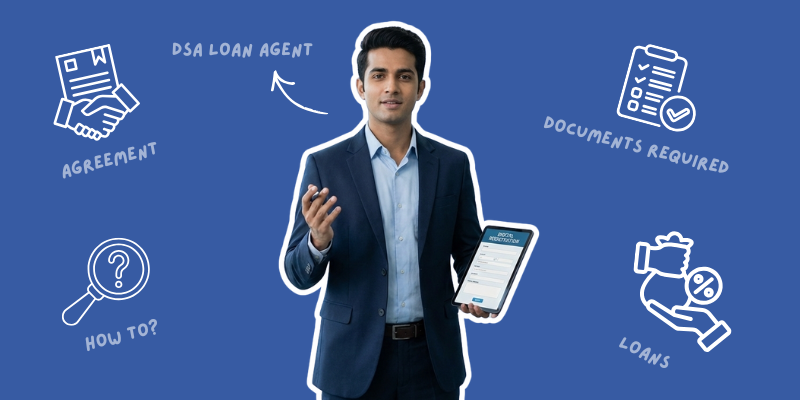


If you regularly meet people who are looking for loans, perhaps a neighbour wanting to renovate their shop, a local teacher looking for a personal loan, or a cousin planning a wedding, becoming a DSA loan agent is often the most practical way to enter loan distribution.
In the busy markets of cities like Indore, Patna, or Coimbatore, the trust factor still beats any fancy mobile app. People in India often find bank branches intimidating and the paperwork confusing. They prefer talking to someone they know, someone who can explain the terms in their local language over a cup of tea.
This is why the role of a Direct Selling Agent (DSA) has shifted from being a corporate "middleman" to a local distribution opportunity. It allows you to use your existing network to help people secure their financial future while you build long-term client relationships.
What A DSA Loan Agent Does In India
Before applying for registration, it is important to understand where the DSA’s role starts and where it clearly ends. Many people think a DSA loan agent approves the loan themselves, but that is a myth. In reality, you are the sourcing partner, the bridge between a borrower's need and a lender's capital. Your job is to find genuine borrowers, help them organise their documents, and ensure the bank receives a "clean" file that is easy to approve.
Many DSAs choose to work through partner platforms such as Choice Connect, which help standardise onboarding, document uploads, application tracking, and follow-ups. This enables the agent to concentrate on sourcing and customer coordination, while the lenders maintain control over approvals and compliance.
Typical tasks include:
- Explaining loan products like Personal loans, Business loans, or a Loan against mutual funds in a non-technical manner.
- Gathering KYC (Aadhaar/PAN) and income documents, and reviewing for typical mistakes such as pixelated images or old address documents.
- Processing applications via an online interface and keeping the customer informed of the status.
- Assisting the bank with the physical or online verification process.
- Following through until the loan amount is actually credited to the borrower's account.
Boundaries and Conduct
To avoid regulatory and customer issues, DSAs must operate within clearly defined boundaries. The DSA role stays strictly on the sourcing and facilitation side. You are not allowed to make decisions on loan sanctions, commit to a "guaranteed" interest rate, or misuse borrower data.
Recent regulatory directions issued by the Reserve Bank of India reinforce that lenders are fully responsible for the conduct of their authorised agents. This means that if the agent is using strong words or is misleading about the interest rate, the bank will face severe consequences. As a professional DSA loan agent, your success is based on your reputation. Since banks must ensure total confidentiality, any slip-up in handling a customer’s personal documents can lead to an immediate ban and the cancellation of your unique DSA code.
Eligibility: Who Can Join the Financial Distribution Ecosystem?
The beauty of this model is that most people entering this role come from non-finance backgrounds. You might be a shop owner who already talks to dozens of people daily, a LIC agent looking to expand their services, or a young graduate in a small town wanting to start a business with zero investment.
The entry requirements are intentionally kept simple to allow wider participation. You don't need a degree from a big college; you just need:
- You must be an Indian citizen and at least 18 or 21 years old (depending on the lender).
- A minimum of Class 10 or 12 pass is usually sufficient.
- A decent credit score (CIBIL) is often checked. If you have defaulted on your own loans, lenders may hesitate to partner with you.
- A smartphone and basic knowledge of using apps for document uploads.
Step-by-Step: DSA Loan Agent Registration
The registration of a DSA loan agent is basically a KYC, verification, and agreement process. In most instances, the delay is due to discrepancies in the KYC or bank information, and not because the process is complicated.
Step 1: Choosing Your Path
You can either register directly with one specific bank (which limits you to their products) or join a multi-lender platform. With the help of partner sites like Choice Connect, DSAs can access multiple lenders with just one login and a streamlined process, thus avoiding the repetition of the onboarding process.
Step 2: Documentation Submission
You will need to provide:
- Identity & Address Proof: Aadhaar and PAN are mandatory.
- Bank Details: A cancelled cheque or a passbook copy so your commissions can be credited directly.
- Photographs: Recent passport-size photos for your ID card and portal profile.
- Business Proof: If you are registering as a firm or a company, you may need GST or the Shop Act registration.
Step 3: Background Verification
The lender's legal team will verify your documents and conduct a "due diligence" check. They want to make sure that the individual representing their brand has a clean reputation and is genuinely interested in the business.
Step 4: The Agreement & Code Generation
Once you are approved, you will be asked to sign a DSA agreement. The DSA agreement is a legal contract that defines your commission rates, targets (if any), and code of conduct. After signing, you will be given a unique DSA Code. This code is your digital signature. Every application you submit is tagged with this code to ensure you get paid accurately and on time.
Commission Structure & Payout Realities
When you start as a DSA, your earnings are tied to "Disbursed Amounts", the money actually handed to the borrower rather than just the "Applied Amount." It is vital to remember that these figures are not fixed. Commission rates fluctuate based on market conditions, the specific policies of the bank, and your overall performance as a partner.
Typical Commission Ranges in 2026 (Indicative Only):
Commission structures differ by lender, borrower profile, product type, and prevailing policies
| Loan Type | Typical Commission Rate | Why does it vary? |
|---|---|---|
| Personal Loan | 1.0% to 2.50% | Risk is higher, leading to more competitive agent payouts. |
| Business Loan | 1.5% to 2.5% | Depends heavily on the industry type and the loan ticket size. |
| Loan Against Mutual Funds | 0.5% to 1.0% | Fast-growing digital product with quicker processing times. |
Note: These rates are subject to change. It does not commit to or guarantee specific earnings, as payouts depend entirely on the lender's current policies and the successful closing of loan files.
How Choice Connect Empowers Local Partners
In the past, working as a loan agent was a lonely and tiring job. You had to visit bank branches multiple times just for a single status update. Modern platforms have completely changed this experience, especially for individuals in Tier 2 and Tier 3 cities who want to run a professional business from their own neighbourhood.
When you register through Choice Connect, you aren’t just getting a DSA code; you are getting a digital infrastructure. Instead of working in the dark, you get:
- Direct Human Support: Every partner is connected with Relationship Managers (RMs). These experts help you understand which bank is the best fit for your specific client, saving you from unnecessary rejections.
- Ready-to-Share Assets: You get access to reading material to pitch to clients that is professionally designed. You can share these directly on WhatsApp or print them to build local awareness.
- Consolidated Dashboards: A single screen allows you to check renewals for products or see exactly where a loan file is stuck. This transparency helps you answer your clients with confidence.
- Skill Development: The platform hosts regular sessions to explain new RBI norms or how to handle difficult customer queries, helping you develop deeper product understanding and client-handling skills over time.
Ground Realities: Building Trust in India
The DSA business will continue to grow when the processes remain simple. Most problems in DSA businesses are caused by a lack of communication, not process problems. If you tell a customer that their loan will be approved in 24 hours, but the bank’s internal check takes 4 days, the customer will stop trusting you.
Practical Conduct Rules for Success:
- Be Honest: You must disclose the terms and conditions of the lender and avoid using verbal “assurance” for approval.
- Data Privacy: You must only use essential documents and keep the confidentiality of the customer’s data.
- Record Keeping: Maintain a simple diary or digital log of every application. This helps you explain delays to your customers factually.
- Professionalism: Stay within the permitted calling hours (usually 8 AM to 7 PM) and always keep communication respectful.
s
Using these practices helps avoid complaints, clawbacks (where the bank takes back a commission if a loan is cancelled early), and account suspension.
Conclusion: A Career for the Long Term
Being a DSA involves following a certain procedure; it does not ensure approvals or commission-based payouts. However, for those who are willing to learn and stay consistent, it offers a path to a professional career with zero investment. By using modern tools and building deep trust in your community, you can turn this role into a full-scale financial consultancy.
Disclaimer: Choice Connect is a platform designed to support individuals who want to build a long-term role as financial advisors or distribution partners. This platform provides learning resources, training, marketing support, and digital business tools to help manage loan sourcing, tracking, and client servicing in a structured way.

