
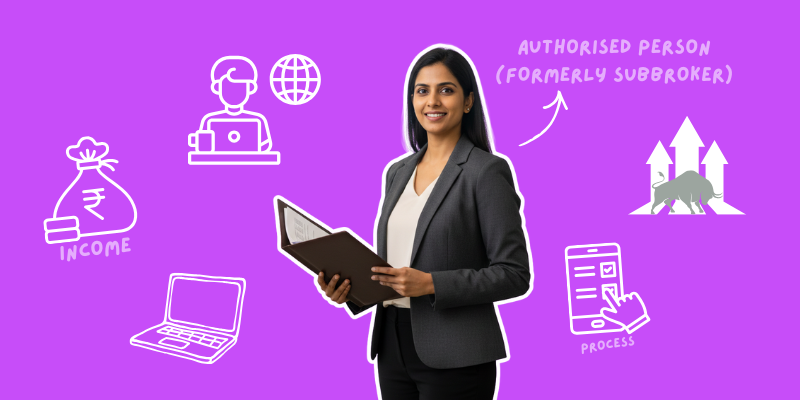


The number of retail investors in India has also seen a sharp escalation, from 4 crores in 2020 to 14 crores in 2024. Even though the number of investors in the metro cities has shown a large escalation, a number of investors in tier-2 and tier-3 cities still experience difficulties in accessing help and support in their region. Here, a distinct need emerges where help in the form of local financial intermediaries becomes essential.
This gap is where a sub-broker steps in- someone local, approachable, and trusted. For a simplified understanding, a sub-broker can be defined as a local navigator who can help investors with Demat Account Opening, Document Submissions, and trading assistance. Before getting started, it’s important to understand how the sub-broker business actually works.
Clarity note: Presently, for becoming a sub-broker, there’s a provision in place named Authorised Person (AP), defined by SEBI, administered through stock exchanges, using SEBI-registered brokers.
What Does a Sub Broker (Authorised Person) Do?
To start operations, individuals are registered as Authorised Persons with a SEBI-registered stockbroker. They are frequently the initial contact for investors, and particularly new investors seeking to acquire stocks.
The typical role may include assisting clients in opening demat and trading accounts, document handling, explaining how trading platforms work, and handling basic investment choices like equity or mutual funds. Intermediaries also tend to educate investors in a small group setup/individual setup in order to gain the trust of a community in a particular geographic location.
Earnings are typically linked to brokerage generated from client activity, making income gradual and closely tied to the size and engagement of the client base.
How Choice Connect Supports Sub Broker Partners?
Authorised Persons are registered with Choice International Pvt Ltd, a SEBI-registered stockbroker. Choice Connect functions as the partner enablement platform that supports APs in managing clients, accessing products, and running their business efficiently. Choice Connect supports individuals who want to work under the Authorised Person model, particularly in tier-2 and tier-3 cities. Partners receive help with getting started, documentation, and access to learning resources that explain market concepts in simple terms.
In addition to equity and trading-related services, partners can also explore other financial offerings within the ecosystem. The focus remains on helping partners operate with confidence while building a local investor base.
How to Start a Sub Broker Business?
Each stockbroker follows its own onboarding structure, commercial terms, and support model. Reviewing multiple options before committing can help avoid operational and financial challenges later.
Understanding the Broker’s Business Model
Before onboarding, it is important to understand how the broker structures its sub-broker or AP model. This includes the client acquisition process, the revenue or commission sharing mechanism, and the effort required to build a client base that can generate recurring monthly income.
Sub Broker Franchise Fees and Deposits
In most cases, these brokers require either a refundable security or a franchise charge. These fees depend on the broker, market segments covered, or even whether it is a sub-branded or direct business relationship.
Preparing Basic Infrastructure
To be functional, sub-brokers would require some small office space or working area, a computer or a laptop, and internet connectivity. Some brokers offer these services by providing access to trading terminals and systems; others would have partners do the necessary arrangements.
Eligibility Criteria and Documents (AP Framework)
SEBI and stock exchanges provide guidelines for the eligibility criteria of individuals/companies applying under the Authorised Person model. Organizing these criteria early helps avoid delays or rejection.
Individual Applicants
The applicant must be an Indian national, above 18 years of age, with the minimum prescribed educational qualification. The candidate must have no convictions for fraud, financial irregularities, or violations of trust. Additionally, the candidate must have a clean financial track record with no exchange prohibition, cases of insolvency, or loan defaults.
Partnership Firms, LLPs, and Companies
It is necessary that every partner or director satisfy the criteria for individuals separately. Additionally, the constitutional documents for the entity have to allow for the dealing of securities. Incorporation certificates, partnership deeds, deeds for the LLP, and transparent shareholding have been required.
Education Requirements
The SEBI specifies minimum requirements for eligibility for Authorised Persons. However, for brokers, one may require more educational qualifications, like graduation, based on the product and level of responsibilities.
Commonly Required Documents
The list of required documents includes identity proof in the form of PAN and Aadhaar, proof for all addresses, educational documents, proof for bank accounts, recent pictures, and business papers, as needed.
Qualifications and Skills Required for a Sub Broker
Even if some brokers choose to hire people who have done a bachelor’s degree in finance, business, or commerce, overall, becoming a successful sub-broker requires more skill than education.
Knowledge of stock market instruments, communicating such concepts effectively to clients, familiarity with online trading systems, and the ability to nurture investors at the local levels are necessary. Integrity, adherence to SEBI and broker requirements, and perseverance, since income builds over a period of time, are equally required.
Choosing the Right Sub Broker Model
Each broker has its own commercial and operational structure. Careful comparison can help ensure expectations meet reality.
The critical factors that need to be analyzed are brand value, product diversity, technological and automation facilities, access to training and educational resources, transparency of the commission structures, and revenue share. Entrepreneurs in smaller towns may begin with a home office setup and then enhance it as the size of their customer base increases.
Registration Process Under the AP Framework
To start operations, individuals go through an onboarding process via a SEBI-registered stockbroker on the Authorised Person model. This involves choosing a stockbroker that supports and engages with the AP model and has commercially viable terms. The next step involves the submission of required documentation and completed application forms.
In the Choice ecosystem, AP registration is completed through Choice Broking, while Choice Connect is used for day-to-day operations, learning, and business management.
The broker applies to the stock exchange for validation. Processing fees, stock exchange fees, and other charges are also applicable in this case, and the amount depends on the broker.
After receiving the approval, he/she receive an exclusive code of registration through which they can start operating a business by onboarding investors.
Key Takeaway
An Authorised Person business may appeal to people who like working with others, teaching about finance-related concepts, or establishing long-term connections within their communities.
The revenue generation or brokerage is slow as it relies on the involvement of customers for trading. Those people who want coaching assistance during the early stages may find the beginning stage more manageable by teaming up with a strong network.

